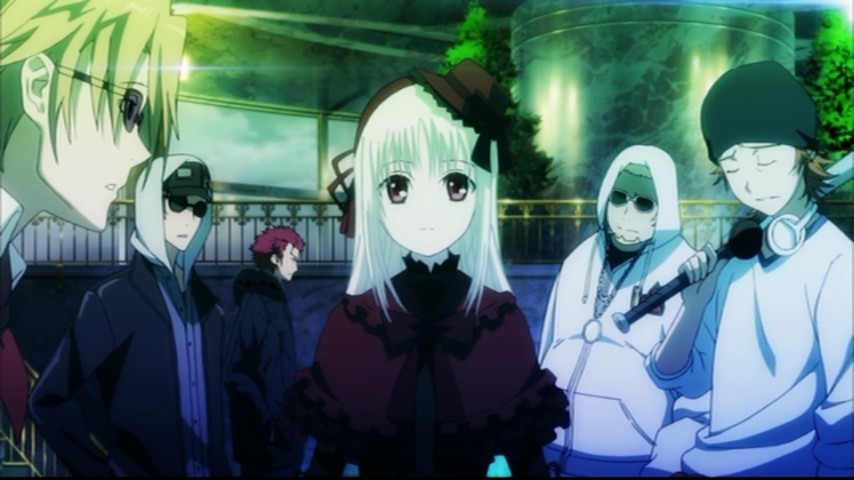
A show that can't be taken seriously isn't the same as a show that's all in fun. A show that's all in fun is all in fun by design (see: Ranma 1/2 — please!); a show that can't be taken seriously defeats its own design. It’s not the fantastic aspects of K that convince me it’s not meant to be taken seriously, but that K tries to tell a story that's too convoluted and potentially knotty for a show with this featherweight an approach to its own material. But boy, oh boy, does it ever look good, even while it's turning out to be about a lot less than it lets on.
K is set in some unspecified future time, when most everyone enjoys an even higher level of technological comfort than we do now, e.g., cleaning robots are common. White-haired, chipper Yashiro Isana attends high school, and his life is normally a pleasant routine of forgetting his school-issued PDA, begging off the largesse of his classmates, and taking lunch on the roof. Then one day all of that is swept away when he's sent to get fireworks for a school celebration and ends up being marked for death by a cold-eyed young man wielding a sword.
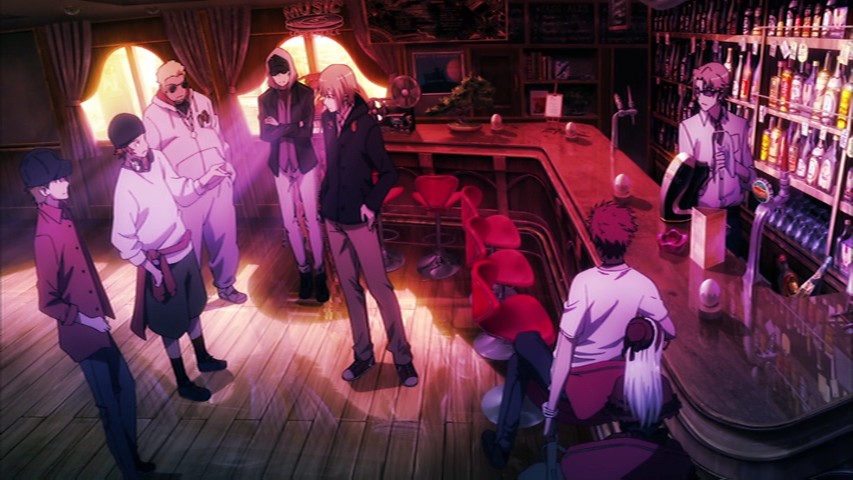
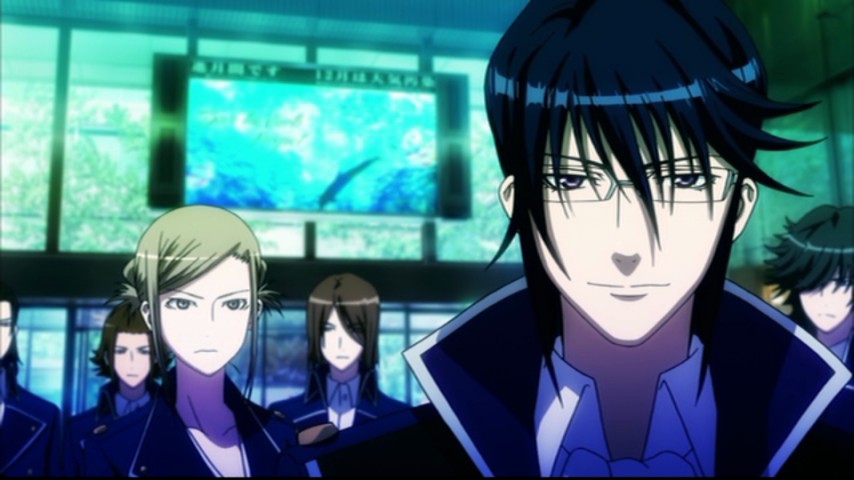
Street-gang attitude vs. reconstructed Shinsengumi.
This fellow is Kurō Yatogami, a member of an outfit known as "Scepter 4", led by the "Blue King". Turns out a group of seven Kings, each identified by a different color and with a different variety of power, have been pulling all the strings in Japan for quite some time. The other night someone who looked a whole lot like Yashiro, and who proclaimed himself to be "the Colorless King" (I wonder now if the staff was reading any David Foster Wallace), shot a man dead on a rooftop and bragged about it to all the world in a blurry cellphone video. Kurō ("Black") is determined that "Shiro" ("White") is the killer, but through a combination of trickery and sincere pleas for common sense — never mind that by the logic of any story, the former should negate any appeals to the latter — Shiro gets Kurō to put aside his vendetta and help him find out the truth.
In theory, this ought to work. And it's not as if the show doesn't have style to burn on top of this idea: the first scene involves the Kurō's "Blues", as they're derogatorily called, clashing with the Red Clan, with the former coming off like reconstructed Shinsengumi and the latter sporting street-gang style. Most every shot is saturated with a glistening spectrum of color — a hallmark of animation team GoHands, also of Mardock Scramble -- and some of the action is magnificently animated. (One later fight between members of the two clans has the Blue member swinging his sword and the Red sporting his skateboard. Nicely done.)
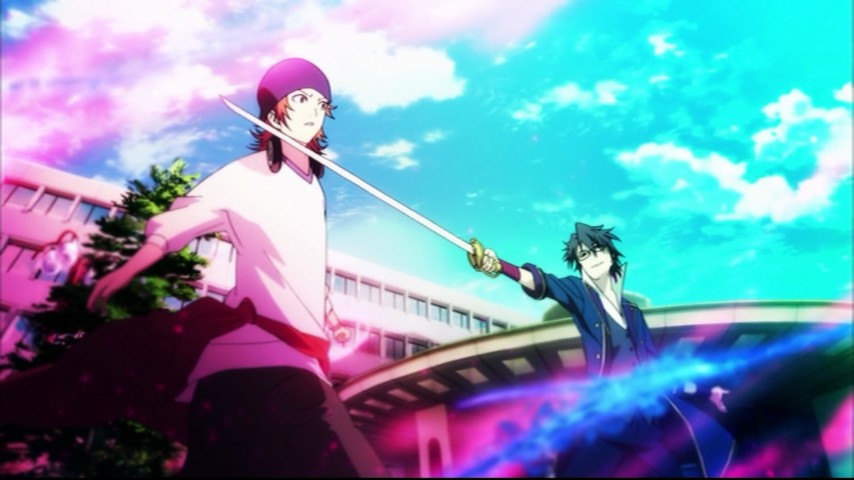
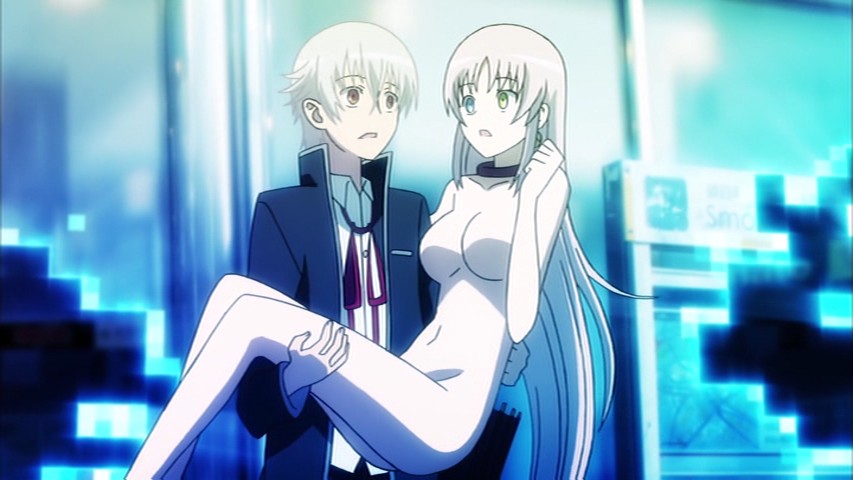
Graphics by GoHands; story by accident.
But inviting as it all is, this style covers a story that's too overstuffed in all the wrong ways to really work. Why the tiresome, not very funny byplay involving the cleaning robots that are constantly making a nuisance of themselves? Why does Kurō have to be, under it all, a soft touch who does goofy things like keep recordings of his master’s late words for inspiration? (This doesn't make him seem like he has a human core; it just makes him seem like the victim of a writer who was trying to quirk him up.)
The resulting damage to the story because of these bad decisions early on means that things which should make sense later just come off as additional self-indulgences. Case in point: Shiro's cat, Neko, who transforms between being a cat and a, well, cat-girl. She, in one of the show's fitfully clever throw-away culture-reference moments, introduces herself with "Wagahai wa neko de aru!" But she seems to serve no purpose in the story other than to be an irritant and a bit of fanservice — every time she transforms, she's naked, ha ha — and by the time her function becomes clear, the show's already earned itself a reputation for being too arbitrary for its own good.
In the same vein, when there comes a big mid-series reveal — you know there had to be one — it doesn't feel like the show's upped its stakes; instead, it just feels like it's making things up as it goes along. That's not a feeling you want in a show that lives or dies according to the strength of its imagination. Subsequent revelations have the same flavor to them: they don't so much elevate the game as they just kick it further down the road. I won't go into the internecine politics that exist between and amongst the various factions, which is just there to generate heat and noise.
Strip away all the baggage the show piles on top of this basic concept — someone has grave doubts about their identity and enlists their own sworn enemy to find out — and you'd have the makings of a story that could be anywhere from good to great. There are moments when K seems to have some idea of how to pull everything together — I particularly liked one bit of non-linear storytelling in episode six that details the backstory of Yashiro's victim — but it never knows how to do justice to those bits as a whole.